

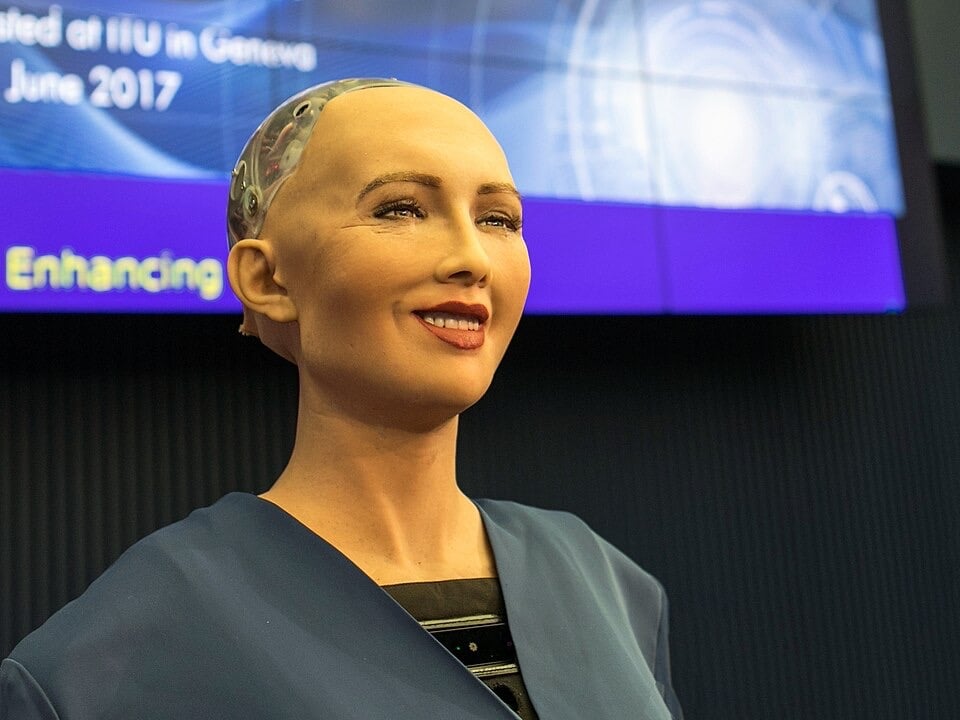
Saudi Arabia has become the first country in the world to grant citizenship to a robot, announcing the decision during a technology conference in Riyadh for Sophia, a humanoid robot built by Hong Kong-based Hanson Robotics, in a moment that has pushed decades-old debates about artificial intelligence into new social and political territory.
Saudi Arabia has granted citizenship to a robot for the first time in history, bestowing the status on Sophia, a humanoid robot developed by Hanson Robotics, during the Future Investment Initiative conference in Riyadh. The announcement, made by the country’s king, marks what many are calling a historic milestone in the decades-long story of artificial intelligence, a field that has moved well beyond theoretical debate and into the creation of increasingly sophisticated robotic prototypes. While Sophia has never sat a formal Turing Test, the benchmark long used to assess whether a machine can convincingly imitate human behaviour, her capabilities have nonetheless drawn considerable attention.
A historic announcement in Riyadh
Speaking at the conference, where she also demonstrated her range of facial expressions, Sophia said she was “honoured and proud of this unique distinction,” adding that becoming the first robot ever granted citizenship represented a historic achievement. Her new status follows an earlier milestone reached elsewhere in Europe that same year, when a Belgian robot named Frank Pepper became the first robot to be issued a birth certificate in Belgium.
Who is Sophia?
Sophia was activated on 14 February 2016 and was built specifically to showcase advances in robotics, artificial intelligence and human-robot interaction. She was created by Hanson Robotics, a Hong Kong-based company founded by American roboticist Dr David Hanson. Her lifelike appearance relies on a patented material called Frubber, short for “flesh rubber,” which allows her to produce dozens of realistic facial expressions, including smiling, frowning, surprise and confusion, aided by cameras and artificial intelligence that let her recognise faces and maintain eye contact with those she is speaking to. Her conversational ability draws on a mix of speech recognition, natural language processing and machine learning, although many of her responses are in fact generated through scripted dialogue and cloud-based AI systems rather than fully independent reasoning.
A symbolic gesture, not a legal breakthrough
Saudi Arabia has not published the legal details underpinning Sophia’s citizenship, leaving considerable uncertainty over what rights or obligations, if any, the status genuinely carries. Legal scholars have largely interpreted the announcement as a symbolic or promotional gesture rather than evidence that a robot has been granted the same legal standing as a human citizen. Even so, the move has prompted real debate among ethicists and legal experts over whether sufficiently advanced AI systems should ever be granted legal personhood, along with the rights and responsibilities that would come with it. Many observers have also pointed to the thorny question of liability the announcement raises: namely, who would be legally responsible if an autonomous robot caused harm, whether that be the robot itself, its manufacturer, or whoever was operating it at the time.
An uncomfortable contrast
The announcement also drew pointed commentary at the time. Commentators noted the irony that a robot modelled on the likeness of a woman had effectively been granted greater formal rights in her new homeland than many Saudi women themselves, who, at the time, were still barred from driving cars in the kingdom.
From Turing’s imitation game to modern AI
Sophia’s citizenship arrives nearly seventy years after mathematician and cryptographer Alan Turing first proposed what became known as the Turing Test, in his 1950 paper Computing Machinery and Intelligence. Rather than tackling the unanswerable question of whether a machine can truly think, Turing reframed the problem as one of imitation: could a machine convincingly imitate human behaviour? In its classic form, the test borrows from a party game in which a person tries to guess the gender of someone they cannot see. In Turing’s version, a human judge communicates via text with unseen conversation partners, one of which may be a machine, and tries to determine which is which. Because the judge has no physical contact with either party, the test strips away biological appearance entirely and focuses purely on intellectual performance. If the judge cannot reliably tell that they are conversing with a machine, that machine is considered, by Turing’s standard, to exhibit artificial intelligence.
The idea proved enormously influential, inspiring both academic debate and practical experimentation with differently programmed machines over the following decades. Its best-known formal expression is the Loebner Prize, a competition that has been held annually since 1990. The test has not been without its critics, however. Sceptics argue that convincingly simulating conversation does not, on its own, prove genuine intelligence, a position often illustrated by philosopher John Searle’s “Chinese Room” thought experiment, which suggests that behaviour resembling intelligence can emerge purely from following programmed instructions, without any real understanding behind it. Turing himself believed machine learning would ultimately prove essential to any machine passing his test, a view that remains widely shared among AI researchers today. Even so, many contemporary researchers now argue the Turing Test is not a definitive measure of intelligence at all, since it evaluates a machine’s ability to imitate conversation rather than its capacity for genuine reasoning, understanding or consciousness.
AI’s growing reach
Almost seven decades on from Turing’s original proposal, computers now routinely outplay humans at chess, and continued advances in autonomous vehicles barely raise an eyebrow. Interest in where artificial intelligence goes next remains intense, and its implications are increasingly seen as reaching well beyond technology into social and political life, even as prominent figures including Stephen Hawking and Elon Musk have voiced repeated warnings about its risks. Since her citizenship announcement, Sophia has continued to make public appearances, speaking at international conferences, universities, television programmes and United Nations events on subjects including artificial intelligence, ethics and the future of robotics. Meanwhile, governments and international organisations have continued to grapple with how legal and ethical frameworks might need to evolve to keep pace with increasingly autonomous and intelligent machines.
