

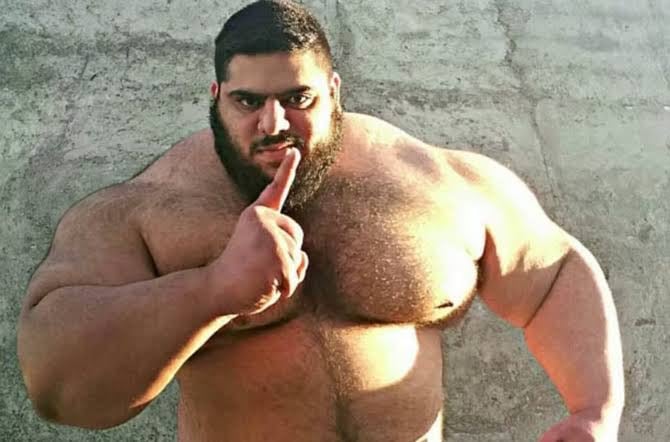
Several major outlets, including the Daily Mail, the BBC and the Independent, reported that Iranian bodybuilder Sajad Gharibi was heading to Syria to fight the Islamic State group, but the claim turns out to be false, and Gharibi himself says he never intended any such thing.
An eye-catching story spread across international media this week claiming that Sajad Gharibi, an extravagantly muscle-bound Iranian bodybuilder known online as the “Iranian Hulk,” was travelling to Syria to fight against militants from the Islamic State group. It made for a compelling headline, but the claim simply isn’t true. Gharibi has never said he intends to fight in Syria, and outlets including the Daily Mail, the BBC and the Independent all repeated a version of the story that does not hold up.
A story too good to check
Gharibi, 24, has built a substantial online following through his bodybuilding, amassing 156,000 followers on Instagram, where he regularly posts shirtless photos showcasing his physique. His larger-than-life build earned him the nicknames “Iranian Hulk” and “Persian Hercules,” titles he has embraced and shared proudly on his own social media accounts. It was against this backdrop of online fame that reports began circulating suggesting he was preparing to take up arms against IS militants in Syria, a claim that quickly spread through international coverage without being properly verified.
How the rumour took hold
The claim that Gharibi was preparing to fight in Syria first spread rapidly in July 2016, fuelled by Iranian media interviews and social media posts that were subsequently picked up and reported by international outlets, resulting in conflicting accounts of what he had actually said. Part of the confusion appears to stem from photographs showing Gharibi wearing military-style clothing, images that were in fact taken during the filming of a music video rather than depicting any genuine military service or deployment.
Setting the record straight
Gharibi has since said his comments were taken out of context and that he never intended to travel to Syria at all. According to Gharibi, he had only ever described himself as “a soldier for my country,” meaning he would defend Iran if its security were ever threatened, not that he planned to join the fighting against IS in Syria. The distinction between defending his homeland in the abstract and actively enlisting to fight overseas appears to have been lost as the story spread from outlet to outlet.
Not the first case of mistaken identity
This was not the first time Gharibi’s appearance had generated false claims online. Before the Syria rumours took hold, he had already drawn attention after some social media users incorrectly claimed he resembled an ISIS executioner known online as “The Bulldozer,” a comparison that, like the later Syria claims, had no basis in fact.
Life after the controversy
If anything, the controversy only boosted Gharibi’s profile, with his social media following growing rapidly as international coverage of the story expanded. In the years since, he has shifted his focus towards combat sports and exhibition boxing, including a widely publicised bout against British bodybuilder Martyn Ford that was ultimately cancelled, before he went on to compete in a separate boxing event. Rather than any military role, Gharibi’s public profile today rests firmly on bodybuilding, media appearances and his continued presence on social media.
