

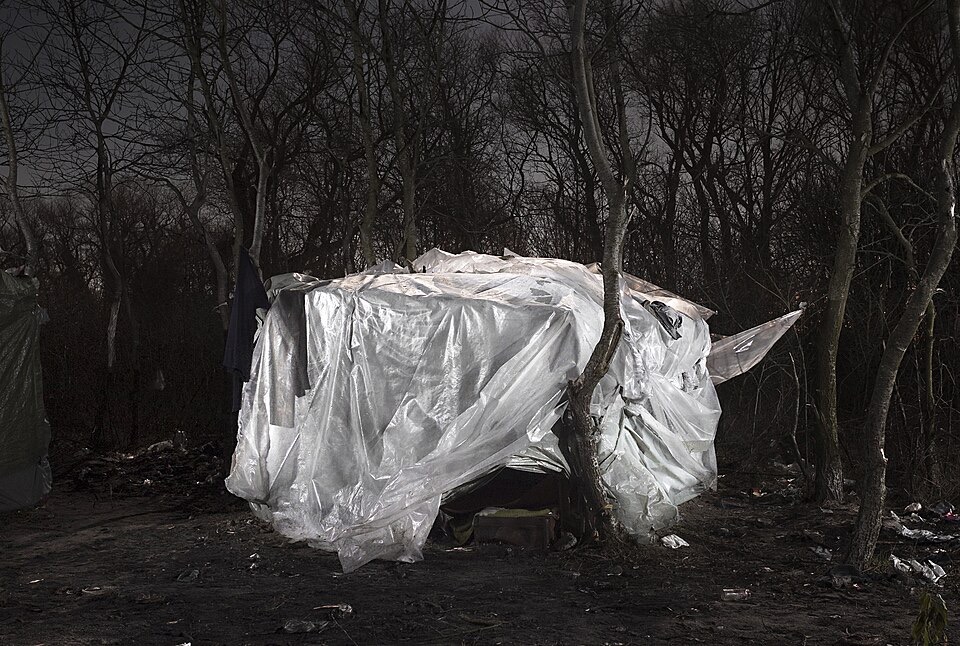
On a disused landfill site on the outskirts of Calais, an entire improvised society took shape as thousands of migrants, hoping to reach Britain, built shops, schools and places of worship out of almost nothing, even as French authorities began demolishing parts of the camp and Paris and London clashed over who should take responsibility for the people living there.
An estimated 5,000 people were living in the makeshift refugee camp known as the “Jungle” on the outskirts of Calais, most of them hoping to eventually reach the UK and claim asylum there. Built on the site of a former landfill, the camp had grown into a functioning, if informal, town of its own, complete with shops, schools and places of worship built from whatever materials were available. Even as French authorities began bulldozing sections of the camp, new arrivals kept appearing daily despite the winter weather, while the French and British governments continued to argue over who bore responsibility for the people living there.
A makeshift town on a former landfill
The Jungle developed as an informal settlement near the French port of Calais, where migrants gathered while waiting for a chance to reach the UK, often by stowing away on lorries, ferries or attempting to pass through the Channel Tunnel. At its height, the camp housed several thousand people from countries including Afghanistan, Sudan, Eritrea, Syria, Iraq, Ethiopia and Iran, with the total population fluctuating from week to week. Despite having no official infrastructure whatsoever, residents built a genuine community within the camp, including shops, cafés, restaurants, barbers, places of worship, schools and community centres. Aid organisations and volunteers ran makeshift schools where both children and adults could learn English, French and other subjects while they waited to learn what would happen to them. Churches, mosques and cultural spaces sprang up throughout the settlement, reflecting the wide range of backgrounds and beliefs among those living there, an entire improvised society built from very little.
Daily struggles and dangerous journeys
Life within the camp remained extremely difficult. Humanitarian organisations repeatedly warned that residents faced poor sanitation, inadequate access to healthcare, severe overcrowding and prolonged exposure to harsh winter conditions, all of which raised the risk of illness among those living there. Volunteers and aid groups working in the camp were equally vocal about the squalid conditions many were forced to endure. For many residents, life in the Jungle was only ever meant to be temporary, and repeated attempts to reach Britain, whether by hiding inside freight vehicles or trying to access the Channel Tunnel directly, carried a serious risk of injury or death.
Clashes and demolition
The camp drew growing attention amid clashes involving its residents, police and local people who wanted to see it dismantled altogether. French authorities began bulldozing sections of the site, arguing that its continued existence posed both public health and security concerns. Even so, the camp kept expanding, with new arrivals continuing to appear daily despite the demolition work already under way and the cold winter conditions. Humanitarian groups criticised the clearance operations, arguing that they simply displaced already vulnerable people rather than resolving the underlying situation. When the camp was eventually cleared in full, many of its former residents did not leave the region altogether, instead relocating to smaller informal camps that sprang up around Calais and nearby Dunkirk.
A political standoff
Behind the scenes, the governments of France and the UK remained locked in disagreement over who should take responsibility for the people living in the camp, even as a de facto new settlement continued to take shape on Calais’s outskirts. The two countries have worked together for years on border security arrangements in the area, with Britain contributing funding for fencing, surveillance technology and policing around Calais aimed at reducing irregular Channel crossings. Under the Le Touquet Treaty, UK border checks are carried out on French soil before travellers board ferries or trains bound for Britain, making Calais a critical point in the UK’s wider border management strategy.
A lasting symbol
The Calais “Jungle” went on to become one of the most recognisable symbols of Europe’s migrant crisis, coming to represent much broader debates over asylum policy, border security and the humanitarian responsibilities of European governments that have continued long after the camp itself was cleared.
