

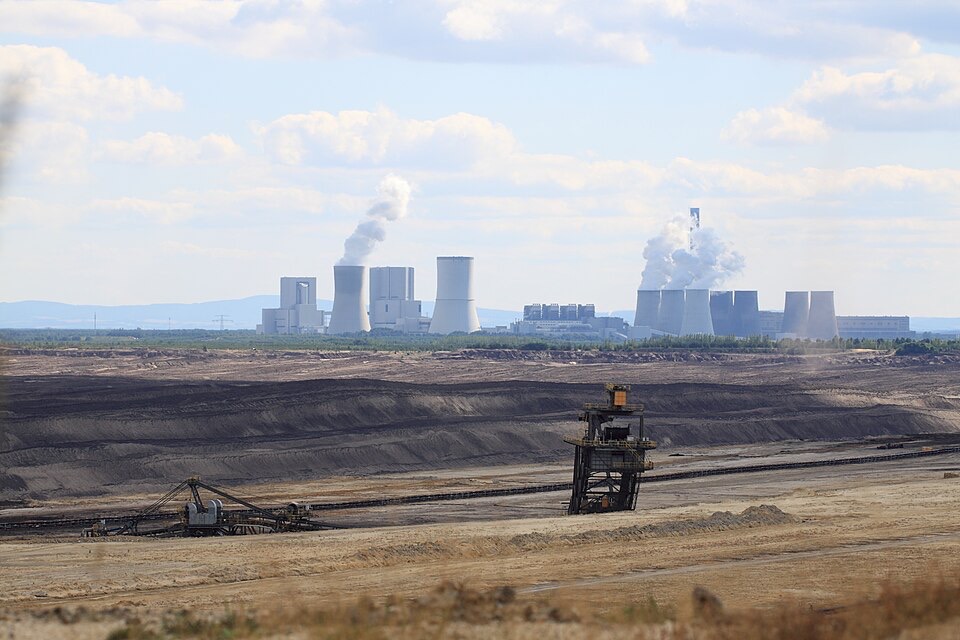
Around 6,000 climate activists from across Europe gathered in Germany’s lignite coal districts for a ten-day Climate Camp, culminating in mass civil disobedience actions that shut down a major coal-fired power plant and saw thousands form a human chain around one of the country’s largest open-pit mines.
Thousands of European climate activists converged on the heartland of Germany’s coal industry for a ten-day gathering that combined protest with grassroots organising. Around 6,000 people took part in Climate Camp, held in Germany’s coal-mining districts from 18 to 29 August, with a main camp based near Erkelenz serving as a hub for workshops and experimental forms of direct democracy. From the outside, the camp’s pitched tents and colourful crowds might resemble a travelling fair; inside, organisers describe it as a self-styled communal utopia bringing together a wide range of social and ecological movements from across the continent, all united around the pursuit of climate justice.
A broad coalition with a single target
The movement drew together a patchwork of autonomous groups, including anarchists, queer activists, environmentalists and pro-immigration campaigners. Despite their differences, the coalition shared one overriding goal, according to Insa Vries, a student from Berlin and spokesperson for Ende Gelände, one of the most prominent anti-coal groups involved in the protests: to “block coal infrastructure, to call for an immediate phaseout” of lignite mining. Alongside direct action, Climate Camp also incorporated workshops, discussions and training sessions, aiming to educate participants on climate issues as well as coordinate protest activity.
Inside Germany’s brown coal heartland
Set in an otherwise rural landscape west of Cologne, four coal-fired power plants operated by the energy company RWE send plumes of white smoke into the sky, fed by three vast open-pit lignite mines that have swallowed up fields, roads and entire villages in the process of powering Germany’s economy. Together, these plants form the largest single source of CO2 emissions anywhere in Europe, a stark illustration of the country’s continued reliance on coal despite its much-publicised commitment to an “energy transition” away from fossil fuels. Lignite, or brown coal, is considered the most carbon-intensive form of coal, producing more CO2 per unit of electricity generated than either hard coal or natural gas.
Germany’s Rhineland lignite mining region is among the largest open-cast coal mining areas in Europe, with mines extending across thousands of hectares. Over the decades, entire villages have been relocated to make way for their expansion, displacing thousands of residents from their homes. Protesters have for years opposed the continued growth of the Hambach and Garzweiler open-pit mines, arguing that they destroy forests, farmland and established communities. The nearby Hambach Forest became an international symbol of the climate movement after activists occupied the woodland for years in an effort to stop it being cleared for mining. As Eva Weinstein, a protester who cycled to the camp from London with around 40 fellow activists, put it: “Brown coal mines are not a local problem; they are an international problem.”
Blocking the tracks to Neurath
At a satellite camp near Bedburg, around 1,600 activists from Ende Gelände, whose name translates as “here and no further,” gathered on the Saturday wearing mock hazmat suits as a police helicopter circled overhead. The group, known for organising mass civil disobedience campaigns against coal infrastructure across Germany, had spent nine hours the previous day blocking the rail tracks that supply lignite to the Neurath power plant, which releases an estimated 88,000 tonnes of CO2 into the atmosphere every day. It was one of several such actions carried out by the group that week.
Setting off again across country roads and farmland, lines of protesters attempted once more to reach and occupy the tracks. To evade police, the group relied on a tactic refined over several years of demonstrations: organising into so-called “fingers,” groups of roughly 100 to 300 people who move together even as the wider protest disperses, spreading police resources thin while allowing activists to target coal infrastructure directly. After what amounted to a prolonged game of cat and mouse with police, around 200 protesters succeeded in reaching an embankment and blocking the tracks feeding the Neurath plant, shutting it down for six hours. Hundreds of protesters were subsequently removed by police and taken to temporary detention facilities, part of a policing operation that, given the scale of such demonstrations, typically involves thousands of officers alongside helicopters, mounted units and surveillance teams. Julia Verlinden, a parliamentary observer from the Green Party, said the willingness of so many young people to risk detention “shows how serious are their concerns about climate change.”
A human chain around Hambach mine
Separately that same Saturday, around 3,500 protesters formed a two-kilometre human chain near RWE’s Hambach coal mine, while a smaller group locked themselves to a conveyor belt inside the mine itself before being taken into police custody.
The wider argument over Germany’s coal future
Climate activists argue that ending lignite mining is essential if Germany is to meet its national climate targets and its commitments under international climate agreements, pointing to the pollution caused by burning lignite, which environmental organisations say contributes not only to greenhouse gas emissions but also to air pollution through sulphur dioxide, nitrogen oxides and fine particulate matter. Supporters of the coal industry, however, argue that lignite has historically provided reliable baseload electricity, helping to maintain energy security while supporting thousands of jobs in the region. Germany has committed to phasing out coal-fired electricity generation altogether, though the precise timetable for doing so remains the subject of ongoing political debate between environmental groups, industry representatives and regional governments. As a result, the Rhineland coal region has become one of the most prominent centres of climate activism in Europe, drawing campaigners from dozens of countries for coordinated demonstrations of this kind.
