

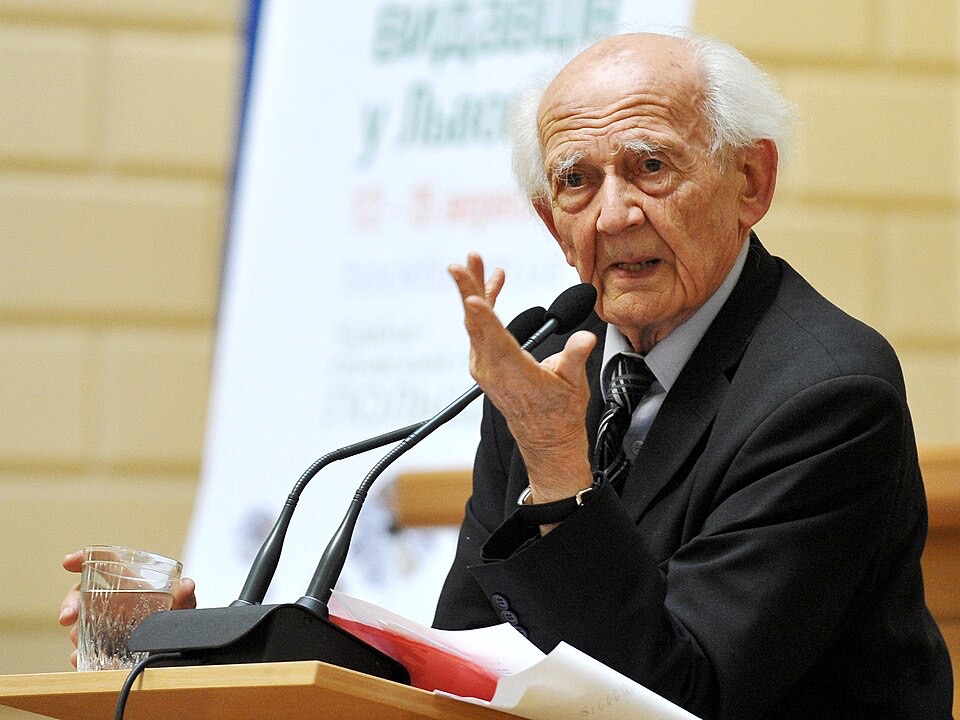
Zygmunt Bauman, the Polish-born sociologist whose work reshaped how scholars understand modernity, the Holocaust and consumer society, has died aged 91, leaving behind a body of work built around his best-known concept of “liquid modernity.”
Zygmunt Bauman, the Polish sociologist best known for connecting modernity, the Holocaust and the rise of consumer culture, has died at the age of 91. Bauman was forced to leave Poland in 1971 amid an anti-Semitic campaign, later settling in the United Kingdom, where he became a professor of sociology at the University of Leeds. Over a career spanning several decades, he developed some of the most influential sociological ideas of recent times, from his theory of the “outsider” to his widely cited concept of “liquid modernity,” which described a world in which institutions, careers and relationships had become increasingly unstable.
A life shaped by exile
Born on 19 November 1925, Bauman spent much of his career grappling with questions of order, insecurity and belonging, themes shaped in part by his own experience of displacement. Having left Poland in 1971 due to an anti-Semitic campaign in the country, he rebuilt his academic career in Britain, taking up a professorship in sociology at the University of Leeds, where he remained closely associated with the department for the rest of his working life. He died on 9 January 2017.
Modernity, bureaucracy and the “outsider”
In the late 1980s and early 1990s, Bauman published a series of books examining modernity, bureaucracy, rationality and social exclusion. He shared Freud’s view that European modernity represented a trade-off, in which societies agreed to give up a degree of freedom in exchange for greater personal security. Bauman argued that this arrangement relied on the control of nature, rigid bureaucratic structures, and an ever-expanding web of rules and regulations, all aimed at gradually eliminating individual insecurity and making the unpredictable elements of life feel ordered and manageable.
Over time, however, Bauman came to argue that this pursuit of order never truly succeeded. However tightly a society organises itself, he suggested, there will always be groups of people who resist being managed, categorised or controlled. In his book Modernity and the Social Environment, Bauman developed the figure of the “outsider” to capture this idea, drawing on the sociological work of Georg Simmel and the philosophy of Jacques Derrida to portray the outsider as a strange, detached participant within society. He explored how consumer-driven economies could simultaneously court the unfamiliar outsider, through the appeal of new foods, fashions and travel, while leaving that same figure trapped in a state of fear precisely because they could not be fully controlled or absorbed into the social order.
Modernity and the Holocaust
Bauman’s best-known and most widely discussed work, Modernity and the Holocaust, sought to bring these ideas of order, fear and control to bear on one of the twentieth century’s greatest atrocities. Drawing on Hannah Arendt and Theodor Adorno’s writing on totalitarianism and the Enlightenment, Bauman argued against viewing the Holocaust simply as an isolated episode in Jewish history, or as a relapse into pre-modern barbarism. Instead, he contended that it was deeply bound up with modernity itself and the broader drive towards rationalisation. He pointed to the systematic division of labour, the dehumanising classification of different groups of people, and a tendency to equate rational control with moral superiority as factors that together helped make the Holocaust possible. Bauman went on to argue that modern society had not fully absorbed the lessons of the Holocaust, describing it as something closer to a painting hanging on a wall: present, acknowledged, but offering little in the way of genuine enlightenment.
From postmodernism to “liquid” life
By the mid-to-late 1990s, Bauman had turned his attention to two closely linked themes: postmodernism and consumerism. He argued that the second half of the twentieth century had marked a decisive shift, as Western societies moved from being organised around production toward being driven by consumption. In Bauman’s view, this shift reshaped the old Freudian bargain between freedom and security, as people increasingly gave up security in exchange for greater freedom, purchasing power and the pursuit of enjoyment. In a 1990 book, he described this shift as a movement from the “modern” to the “postmodern.” After the turn of the millennium, keen to avoid confusion surrounding the term “postmodernity,” Bauman instead adopted the metaphors of “liquid” and “solid” modernity. In his writing on consumer society, he continued to explore the uncertainties associated with “solid” modernity, while also identifying a deeper, more persistent form of unease, what he termed “liquid fears,” free-floating anxieties without a clear shape or obvious external cause, of which he cited the fear of paedophilia as one example of a diffuse societal panic.
Liquid modernity: his defining concept
“Liquid modernity” became Bauman’s central description of the contemporary world, contrasted with the more rigid, predictable “solid” modernity that had preceded it. He argued that this shift confronted individuals with an entirely new set of challenges, since social institutions no longer had time to solidify human behaviour or provide a stable framework for long-term planning. As a result, individuals were forced to piece together their lives from an endless series of short-term plans and episodes, rather than following a coherent, linear notion of “career” or “progress.” This fragmented existence, Bauman argued, demanded flexibility and adaptability, a willingness to abandon commitments and loyalties without regret, and constant calculation of the gains and losses involved in acting, or failing to act, amid ongoing uncertainty.
Key ideas and legacy
Across his work, several core ideas recur: that the Holocaust was enabled, not simply interrupted, by aspects of modern bureaucracy and rationalisation; that modern societies create and marginalise “outsiders” who fail to conform to social norms; that Western identity has become increasingly shaped by consumption rather than production; and that contemporary life increasingly trades long-term security for individual freedom, flexibility and choice, at the cost of heightened anxiety and insecurity.
Selected works
Among Bauman’s most influential books are Modernity and the Holocaust (1989), Postmodern Ethics (1993), Life in Fragments (1995), Liquid Modernity (2000), Liquid Love (2003), Liquid Fear (2006) and Consuming Life (2007), a body of work that continues to shape debates in sociology, philosophy and cultural theory today.
